At first glance, a compass bezel filled with tiny hash marks and numbers can look intimidating. However, a compass dial is simply a perfect circle divided into 360 equal parts, called degrees (). Understanding how these numbers correspond to the named directions you already know (North, South, East, West) is the foundational key to accurate land navigation.
The Four Cardinal Directions
Before diving into the numbers, we start with the four primary pillars of navigation, known as the Cardinal Directions. On a 360-degree dial, these are spaced exactly $90° apart:
- North (N): 0° (or 360°, as it completes the circle)
- East (E): 90°
- South (S): 180°
- West (W): 270°
The Ordinal (Intercardinal) Directions
If you split the $90° gaps between the cardinal points perfectly in half, you get the Ordinal Directions (sometimes called primary intercardinal directions). These are spaced at $45° intervals:
- Northeast (NE): 45°
- Southeast (SE): 135°
- Southwest (SW): 225°
- Northwest (NW): 315°
The 16-Point Compass Rose
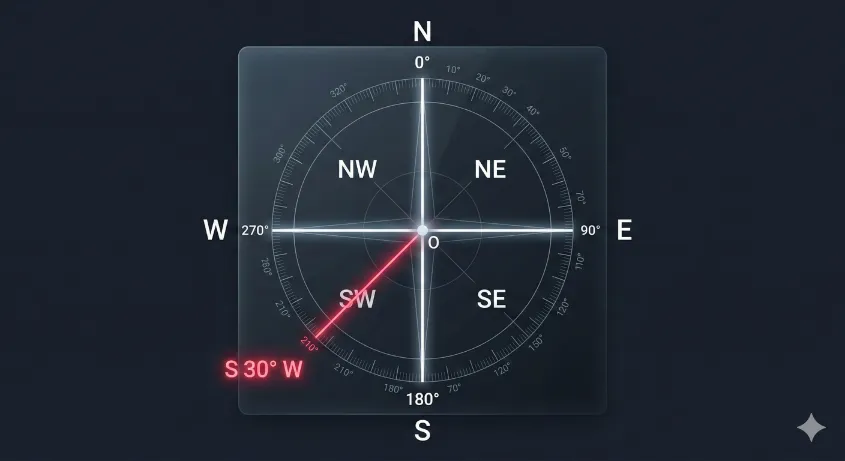
For even more precise communication, navigators divide the circle once more into the 16-Point Compass Rose. This creates secondary intercardinal points (like North-Northeast or West-Southwest). Because we divide $360° by 16 points, each specific direction is separated by exactly $22.5°.
Complete Degree Conversion Table
| Direction Name | Abbreviation | Exact Degree |
|---|---|---|
| North | N | 0° / 360° |
| North-Northeast | NNE | 22.5° |
| Northeast | NE | 45° |
| East-Northeast | ENE | 67.5° |
| East | E | 90° |
| East-Southeast | ESE | 112.5° |
| Southeast | SE | 135° |
| South-Southeast | SSE | 157.5° |
| South | S | 180° |
| South-Southwest | SSW | 202.5° |
| Southwest | SW | 225° |
| West-Southwest | WSW | 247.5° |
| West | W | 270° |
| West-Northwest | WNW | 292.5° |
| Northwest | NW | 315° |
| North-Northwest | NNW | 337.5° |
Why Use Degrees Instead of Names?
[Image showing the mathematical spread of a 1-degree error over a long distance]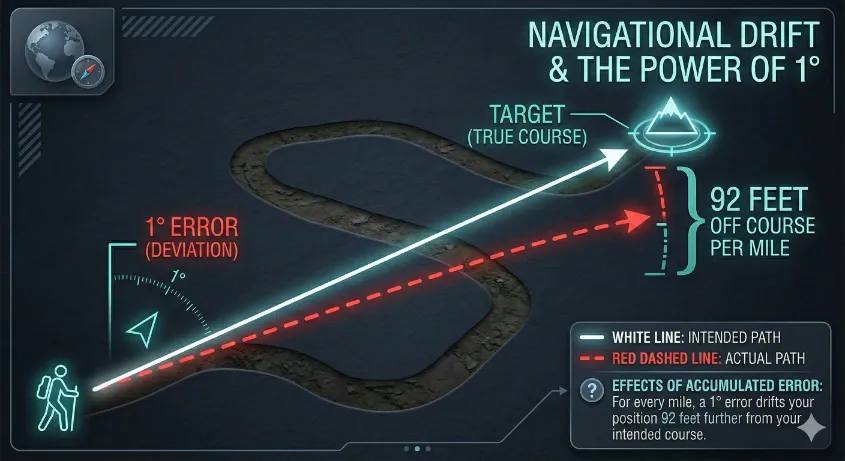
You might wonder why we bother with specific numbers like 112.5° when we could just say "walk East-Southeast." The answer comes down to the brutal mathematics of wilderness navigation.
Saying "walk Southeast" gives you a massive 45° margin of error (anywhere between 112.5° and 157.5°). If you are trying to find a specific bridge across a treacherous river, this margin of error is deadly.
The Rule of 60: For every 1° you are off course, you will miss your target by roughly 92 feet (about 28 meters) for every mile traveled. If you guess "Southeast" instead of dialing in exactly 135° on your compass bezel, walking just one mile could put you thousands of feet away from your destination. Reading the exact degree ensures pinpoint accuracy.
Frequently Asked Questions
What direction is 270 degrees?
On a standard compass rose, 270° corresponds exactly to West. It is one of the four cardinal directions, located three-quarters of the way around the compass dial from North.
How many degrees are in a full compass circle?
A standard civilian compass is a perfect circle divided into exactly 360 degrees. North is 0°, East is 90°, South is 180°, and West is 270°. Once you pass 359°, the circle resets at 0° (North).
What does a bearing of 045 mean?
In navigation, bearings are often written as three-digit numbers to avoid communication errors over radio. A bearing of "045" means exactly 45 degrees, which corresponds to the Northeast direction.