With the advent of highly accurate smartphone GPS, smartwatches, and dedicated satellite communicators, many hikers and outdoor enthusiasts wonder if the traditional magnetic compass is finally obsolete. The short answer? Absolutely not. While both are powerful navigation tools, they serve completely different fundamental purposes and rely on entirely different technologies to keep you from getting lost.
How Do They Work? The Technology Behind the Tools
To understand why one cannot fully replace the other, we must look at how each device gathers its information.
A GPS (Global Positioning System) relies on an external network of satellites orbiting the Earth. Your device acts as a receiver, picking up radio signals from at least four different satellites. By calculating the time it takes for those signals to arrive, the GPS uses a mathematical process called trilateration to pinpoint your exact coordinates (latitude, longitude, and altitude) on the globe.
A Magnetic Compass, on the other hand, is an entirely self-contained instrument. It does not communicate with any external network. Instead, its magnetized needle reacts physically to the Earth's natural magnetic field. Because the Earth's molten iron core generates magnetic lines of force that flow between the poles, the compass needle will always align itself to point toward Magnetic North.
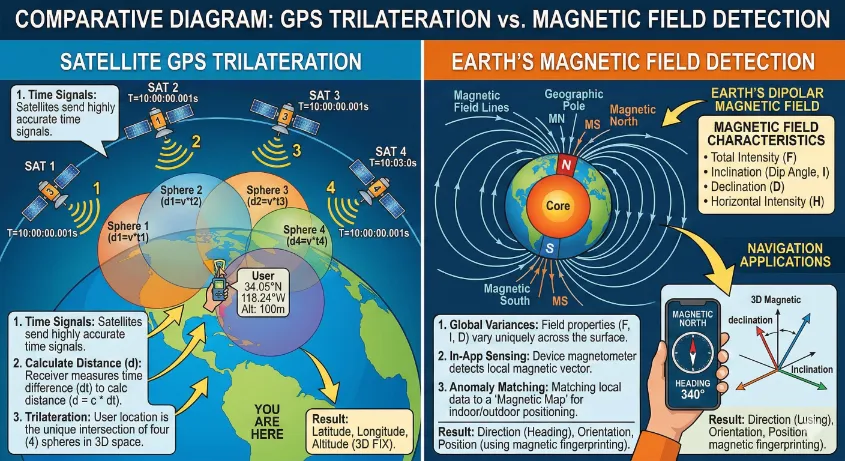
The Core Difference: Location vs. Direction
The easiest way to understand the "Compass vs GPS" debate is to memorize this rule:
- A GPS tells you exactly where you are.
- A compass tells you exactly which direction you are facing.
A standard GPS receiver cannot tell which direction you are facing while you are standing perfectly still. It must calculate your heading by tracking your movement over a distance. If you are standing at a fork in the trail in dense fog, a GPS will show your location as a dot on a map, but a compass will instantly tell you which path leads North.
Head-to-Head Comparison Table
| Feature | GPS Device | Magnetic Compass |
|---|---|---|
| Primary Function | Determines absolute location (coordinates) | Determines absolute direction (heading) |
| Power Source | Batteries (requires charging) | None (powered by Earth's magnetism) |
| Environmental Limits | Fails in slot canyons, caves, or dense canopy | Fails near large metal objects or magnetic fields |
| Map Integration | Built-in digital mapping | Requires a physical paper topographic map |
| Durability | Fragile screens, susceptible to extreme cold | Extremely rugged, works in all weather |
Strengths and Weaknesses
The Pros and Cons of GPS
- Pros: Tells you your exact location, tracks your route so you can easily backtrack (breadcrumb trails), calculates your speed and estimated time of arrival, and works perfectly in total darkness or heavy fog.
- Cons: Electronic components can fail. Cold weather rapidly drains lithium-ion batteries. GPS signals require a "line of sight" to the sky, meaning they lose accuracy inside deep ravines, slot canyons, or under heavy jungle canopy.
The Pros and Cons of a Compass
- Pros: 100% reliable. It never runs out of battery, boots up instantly, cannot be broken by a software glitch, and allows you to "project a bearing" visually across a landscape to a distant mountain peak.
- Cons: Cannot tell you where you currently are without performing complex triangulation on a paper map. Requires training and practice to use effectively. Susceptible to local magnetic declination variations.
The Verdict: Two is One, One is None
In wilderness survival and professional navigation, there is a saying: "Two is one, and one is none." You should never rely solely on a piece of electronics to keep you alive in the backcountry.
The modern standard is to use a GPS for primary navigation because of its speed and convenience, but always carry a map and compass as a mandatory backup. By combining the pinpoint location data of a GPS with the directional accuracy of a compass, you achieve the ultimate navigational awareness.
Frequently Asked Questions
Do I need a compass if my phone has GPS?
Yes. A smartphone relies on a battery that can die quickly in cold weather or when constantly searching for a signal. If your phone dies, drops, or gets wet, a physical compass and paper map are your only ways to navigate safely back to civilization.
Does GPS work without cell service?
Yes. The GPS chip inside your phone or dedicated device receives radio signals directly from satellites in space. It does not require cellular towers or Wi-Fi to determine your coordinates. However, you must download digital maps for offline use beforehand, as the map images themselves require an internet connection to load.
Why does my GPS compass point the wrong way when I stop moving?
Unless your GPS device has a built-in 3-axis electronic magnetometer (an internal compass), it calculates your direction by comparing your previous location coordinate to your current one. If you stop moving, it has no data to calculate a trajectory, causing the directional arrow to spin or point incorrectly.