While civilian compasses are divided into 360 degrees, military forces around the world (including NATO) use a vastly more precise system for land navigation, sniper spotting, and artillery targeting: the mil (short for milliradian).
If you have ever looked at a military-issue lensatic compass or through a sniper's rifle scope, you have likely seen this secondary, highly detailed set of numbers. Understanding how mils work reveals the incredible math behind military precision.
Degrees vs. Mils: The Core Difference
Both systems measure angles within a circle, but they use vastly different scales of granularity.
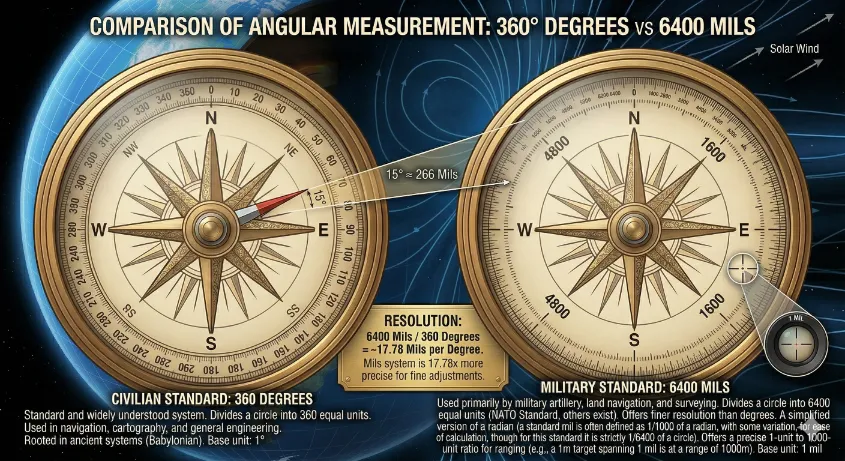
A standard civilian circle is divided into 360 degrees. This is fine for hiking, but if you are firing an artillery shell over several miles, a 1-degree error means missing the target by hundreds of feet.
In the standard NATO military system, that exact same circle is divided into 6,400 mils. This means that 1 degree is roughly equal to 17.78 mils. This massive increase in granularity allows forward observers to call in adjustments with extreme, pinpoint accuracy without dealing with complex decimal points or minutes/seconds of an angle.
| Feature | Civilian Degrees | NATO Mils |
|---|---|---|
| Units in a Circle | 360 | 6,400 |
| Error Margin at 1,000 meters | ~17.4 meters per 1° | Exactly 1 meter per 1 mil |
| Primary Users | Hikers, civilian aviation, mariners | NATO infantry, snipers, artillery |
| Conversion | 1° ≈ 17.78 mils | 1 mil ≈ 0.056° |
The Math Behind the Mil: The W=RM Formula
The entire military mil system is built around a beautifully simple, rapid mathematical principle designed for mental math in combat: An angle of 1 mil subtends (covers) exactly 1 meter of width at a distance of 1,000 meters.
This allows soldiers to instantly calculate the distance to a target simply by measuring how wide or tall it appears in the mil-dot reticle of their binoculars or scopes using the Mil Relation Formula:
Example: A forward observer sees an enemy tank. The observer knows this specific model of tank is exactly 3 meters wide (the Width). Looking through their binoculars, the tank takes up exactly 2 mils on the reticle (the Mils).
$ rac{3 imes 1000}{2} = 1500$. The tank is exactly 1,500 meters away.
Why 6,400? The NATO Rounding Rule
Mathematically speaking, a true "milliradian" is $1/1000 of a radian. Since there are $2\pi$ radians in a circle, a true circle actually contains about 6,283 milliradians ($2 imes 3.14159 imes 1000$).
However, doing mental math dividing numbers by 6,283 while under fire is extremely difficult. After World War I, Western militaries decided to round that number up to a clean 6,400. This number is incredibly easy to divide evenly into halves, quarters, and eighths (3200, 1600, 800, 400), making map adjustments and artillery math much faster and less prone to human error.
Frequently Asked Questions
Can I use a military compass for civilian hiking?
Yes. Almost all military-issue lensatic compasses feature two concentric rings on the dial. The outer ring is usually marked in mils (0 to 6400), and the inner ring is marked in standard degrees (0 to 360). You can simply read the inner ring for standard topographic map navigation.
Do all militaries use the 6400 mil system?
No. While NATO and Western-aligned militaries use the 6,400 mil standard, the former Soviet Union and Warsaw Pact nations rounded down, dividing their compasses into exactly 6,000 mils. The Swedish military historically used 6,300 mils (which is much closer to the true mathematical reality of 6,283).
What is a mil-dot scope?
A mil-dot scope is a telescopic sight commonly used by snipers. The crosshairs feature tiny dots spaced exactly 1 mil apart. By counting how many dots a target covers, the shooter can use the Mil Relation Formula to calculate the exact distance to the target and adjust their aim for bullet drop.