If you have ever looked at a topographic map or held a physical compass, you may have noticed that "North" isn't just one single direction. In the world of outdoor navigation, there are actually two distinct norths you must account for: True North and Magnetic North. Confusing the two can lead you miles off course and into dangerous terrain.
What is True North (Geographic North)?
True North is a fixed, unchanging point on the globe. It is the geographic North Pole—the exact mathematical point where the Earth's axis of rotation intersects the surface in the middle of the Arctic Ocean.
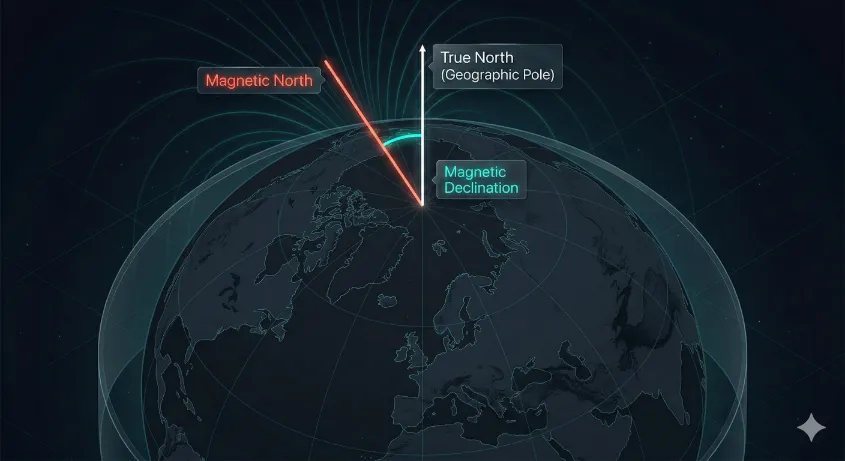
When you look at a printed topographic map, the grid lines running vertically from the bottom to the top always point exactly to True North. Cartographers map the world based on this unchanging geographic reality. If you want to walk from the equator to the geographic North Pole, you are following a True North trajectory.
What is Magnetic North?
Unlike True North, Magnetic North is not a fixed geographic location. It is the point on the Earth's surface where the planet's magnetic field points straight down into the ground.
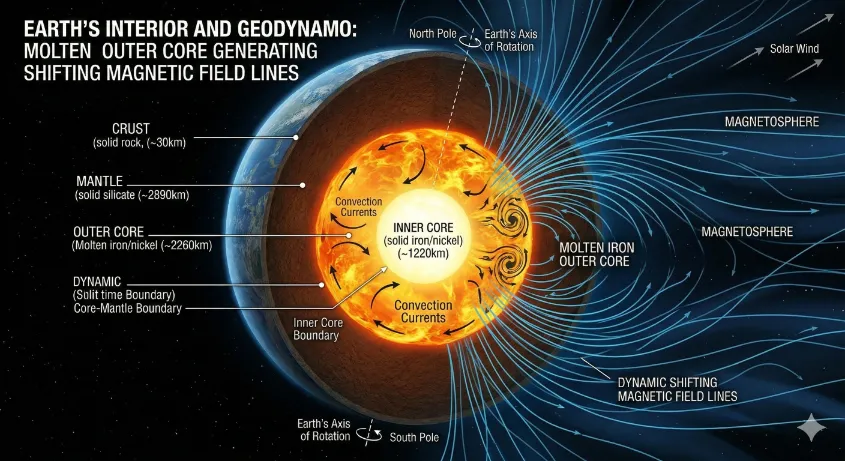
The Earth's magnetic field is dynamically generated by the swirling currents of liquid iron and nickel in the planet's outer core. Because these subterranean fluid currents are constantly shifting, Magnetic North actually moves. In recent decades, it has been drifting from the Canadian Arctic toward Siberia at speeds of up to 35 miles (55 kilometers) per year.
When you hold a digital or physical compass, the magnetized needle naturally aligns itself with these invisible magnetic field lines. Therefore, your compass always points to Magnetic North, not True North.
True North vs. Magnetic North Comparison
| Feature | True North | Magnetic North |
|---|---|---|
| Location | Geographic North Pole | Currently wandering near the Arctic Ocean / Siberia |
| Stability | Fixed and permanent | Constantly shifting (up to 35 miles/year) |
| Used By | Paper topographic maps, GPS coordinates | Magnetic compasses, smartphone magnetometers |
| Alignment | Earth's axis of rotation | Earth's magnetic field lines |
The Gap Between Them: Magnetic Declination
Because True North is fixed and Magnetic North is constantly moving, there is almost always an angle of difference between the two, depending entirely on where you are standing on Earth. This angle is called Magnetic Declination.
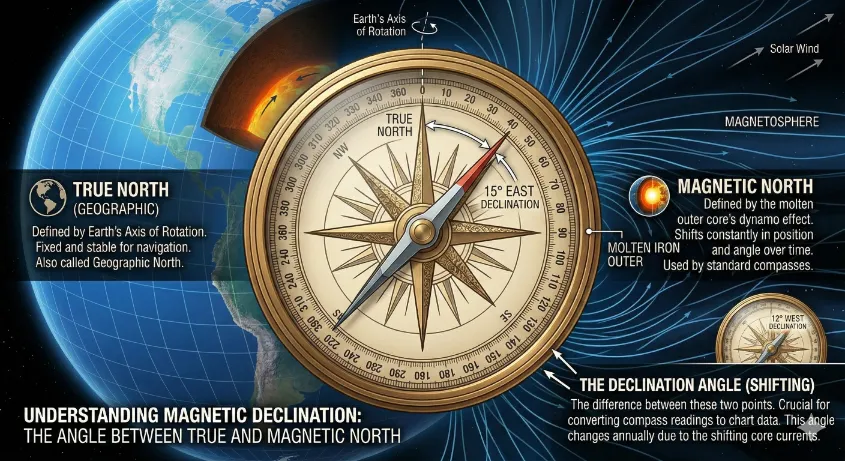
- East Declination: Magnetic North lies to the east of True North from your vantage point.
- West Declination: Magnetic North lies to the west of True North from your vantage point.
- Agonic Line: The rare, invisible line across the Earth where True North and Magnetic North perfectly align. If you stand on the Agonic Line, your declination is zero.
Why This Matters for Navigation
If you take a bearing from a paper map (which uses True North) and follow that exact degree on your compass (which uses Magnetic North) without manually adjusting the math for your local declination, you will travel in the wrong direction.
A navigational error of just 1 degree will put you roughly 92 feet (28 meters) off your target for every single mile you travel. In areas with high magnetic declination (like the Pacific Northwest of the United States or parts of Northern Europe, where declination can easily exceed 15 degrees), failing to convert between True and Magnetic North could result in missing your destination by several miles.
Frequently Asked Questions
Does my phone compass use True North or Magnetic North?
The hardware magnetometer inside your smartphone detects Magnetic North natively. However, most modern operating systems (like iOS and Android) use your device's GPS location to calculate the local magnetic declination in the background. They then automatically apply the math to display True North on your screen. You can usually toggle between "True" and "Magnetic" in your app settings.
What is the Agonic Line?
The Agonic Line is an imaginary, shifting line on the Earth's surface where True North and Magnetic North perfectly align. If you are standing exactly on the Agonic Line, your magnetic compass points directly at the geographic North Pole, and your magnetic declination is zero degrees.
How often does Magnetic North change?
Magnetic North changes continuously every single day due to shifts in the Earth's molten core. Because of this, the National Oceanic and Atmospheric Administration (NOAA) updates the World Magnetic Model every five years to ensure global navigation systems, military targeting, and civilian smartphones remain accurate.