Technology fails, batteries die, and physical compasses can be dropped or broken. Knowing how to locate True North using nothing but your natural surroundings is a critical wilderness survival skill. Whether you are lost in the backcountry or just testing your bushcraft skills, the sun and the stars provide an infallible, built-in navigation system.
1. The Shadow-Tip Method (Daytime)
Because the sun always rises in the east and sets in the west, the shadows it casts move in the exact opposite direction (from west to east). You can use this astronomical constant to draw a highly accurate compass line on the ground.
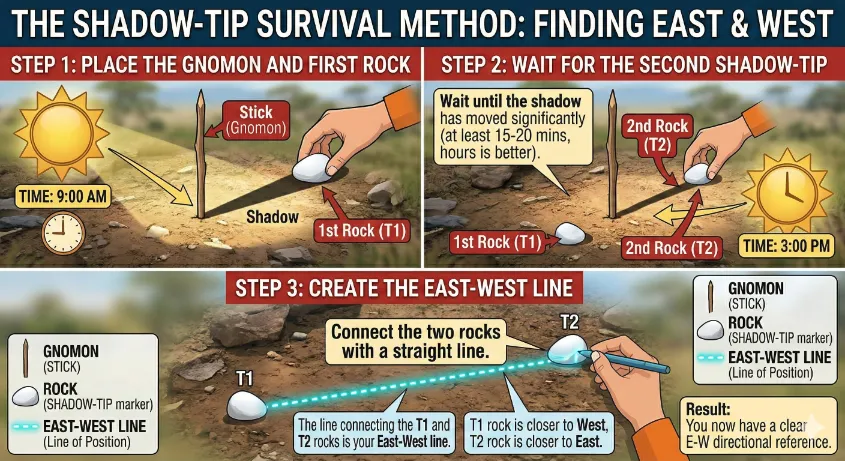
Step-by-Step Instructions:
- Find a straight stick about 3 feet (1 meter) long and push it straight down into a flat, clear patch of dirt.
- Mark the first shadow: Place a small rock exactly at the tip of the shadow cast by the stick. This rock represents West.
- Wait: Give the sun time to move across the sky. Wait at least 15 to 30 minutes. The shadow will move.
- Mark the second shadow: Place a second rock exactly at the new tip of the shadow. This rock represents East.
- Draw your line: Draw a straight line in the dirt connecting the first rock to the second rock. You now have a perfect West-to-East line. If you stand with your left foot on the first rock (West) and your right foot on the second rock (East), you are facing True North.
2. The Analog Watch Method (Daytime)
If the sun is visible and you are wearing a traditional analog watch (with hour and minute hands), you can use it as a makeshift protractor to find your bearing.
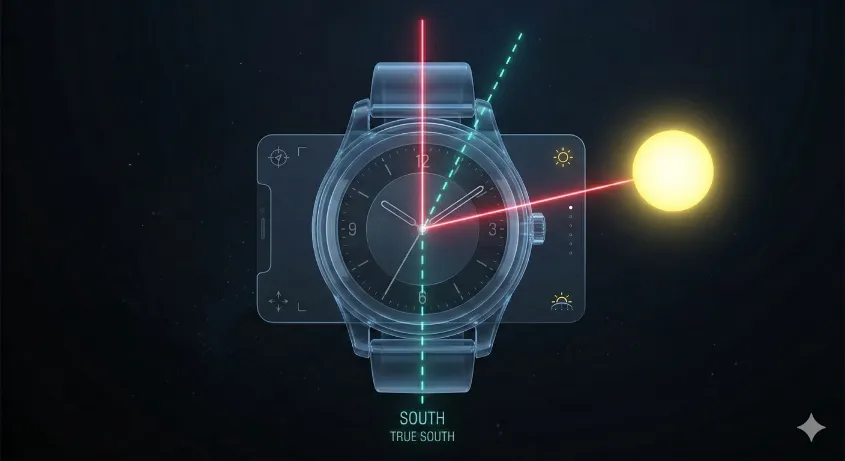
- Northern Hemisphere: Hold the watch flat in front of you. Point the Hour Hand directly at the sun. Find the exact halfway point (bisect the angle) between the Hour Hand and the 12 o'clock mark. That halfway point is South. North is exactly $180^\circ$ in the opposite direction.
- Southern Hemisphere: Point the 12 o'clock mark at the sun. Find the halfway point between 12 o'clock and the Hour Hand. That halfway point is North.
Note: If you are currently observing Daylight Saving Time, use the 1 o'clock mark instead of 12 o'clock.
3. Finding the North Star / Polaris (Nighttime)
In the Northern Hemisphere, Polaris (the North Star) sits almost perfectly above the Earth's geographic North Pole. Unlike other stars that track across the sky throughout the night, Polaris remains virtually fixed, making it the ultimate navigational beacon.
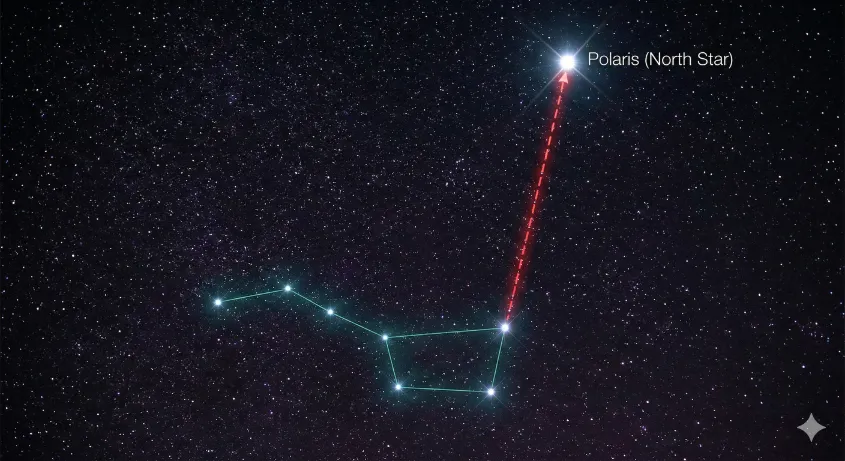
How to locate Polaris:
- Find the Big Dipper (Ursa Major) constellation. It looks like a giant soup ladle in the sky.
- Locate the two "pointer stars" forming the outer edge of the ladle's bowl (named Merak and Dubhe).
- Draw an imaginary straight line through those two stars extending upward from the top of the bowl.
- Follow that line for about five times the distance between the pointer stars. The first bright star you hit is Polaris. Face it, and you are facing True North.
Summary of Natural Navigation Techniques
| Method | Best Time | Hemisphere | Accuracy |
|---|---|---|---|
| Shadow-Tip | Mid-day / Afternoon | Anywhere | High (determines precise E/W axis) |
| Analog Watch | Anytime sun is visible | Northern or Southern | Moderate (rough approximation) |
| Polaris (North Star) | Clear Nights | Northern Hemisphere Only | Extremely High (True North) |
| Southern Cross | Clear Nights | Southern Hemisphere Only | High (Points to Celestial South) |
Survival Navigation FAQs
Is it true that moss only grows on the north side of trees?
No, this is a dangerous myth. While moss prefers damp, shaded environments (which is often the north side of a tree in the Northern Hemisphere), moss will grow anywhere there is moisture. Terrain, nearby water sources, and dense forest canopies can cause moss to grow on the South, East, or West sides of a tree. Never use moss as a primary navigation tool.
How do I find North if it is overcast or raining?
If you cannot see the sun or the stars, and you do not have a compass, natural navigation becomes exceptionally difficult. Look for environmental clues: satellite dishes on houses usually point toward the equator (South in the US/Europe), and prevailing winds shape the growth of isolated trees. However, your safest option is to stay put, build a shelter, and wait for the weather to clear.
Can I find the North Star from Australia or South America?
No. Polaris is completely invisible from the Southern Hemisphere because the curvature of the Earth blocks it. Instead, you must locate the Southern Cross (Crux) constellation and its two pointer stars to find Celestial South, and then turn $180^\circ$ to find North.