In an era of smartphone GPS and digital smartwatches, navigating with a traditional magnetic compass might seem like a relic of the past. However, a physical baseplate compass never runs out of battery, never loses signal in a canyon, and remains the ultimate fail-safe for wilderness survival. Whether you are using a physical baseplate compass or a high-end digital equivalent, understanding the core principles is essential before stepping off the trail.
The Anatomy of a Baseplate Compass
Before you can navigate, you need to understand the instrument in your hand. The most common type of compass for hikers is the baseplate compass, designed specifically to be used in conjunction with a topographic map.

| Compass Part | Description & Function |
|---|---|
| Baseplate | The clear acrylic plastic edge. It allows you to see the map underneath while drawing straight lines between coordinates. |
| Direction of Travel Arrow | The big arrow printed on the baseplate pointing away from the dial. This is the direction you will actually walk. |
| Rotating Bezel (Azimuth Ring) | The outer dial marked with 360 degrees. You turn this to dial in your specific bearing. |
| Index Line | The small tick mark directly above the bezel where you read your exact degree bearing. |
| Magnetic Needle | The floating needle floating inside the housing. The red end always points to Magnetic North. |
| Orienting Arrow | The fixed, outline arrow printed on the bottom of the rotating housing. Used to align the magnetic needle. |
| Orienting Lines | Parallel lines inside the housing used to align the compass with the North-South grid lines on a map. |
Step 1: Taking a Bearing from a Map
A "bearing" is simply the exact angle you need to travel to reach your destination. To travel from your current location (Point A) to a distant mountain peak or campsite (Point B), follow these steps:
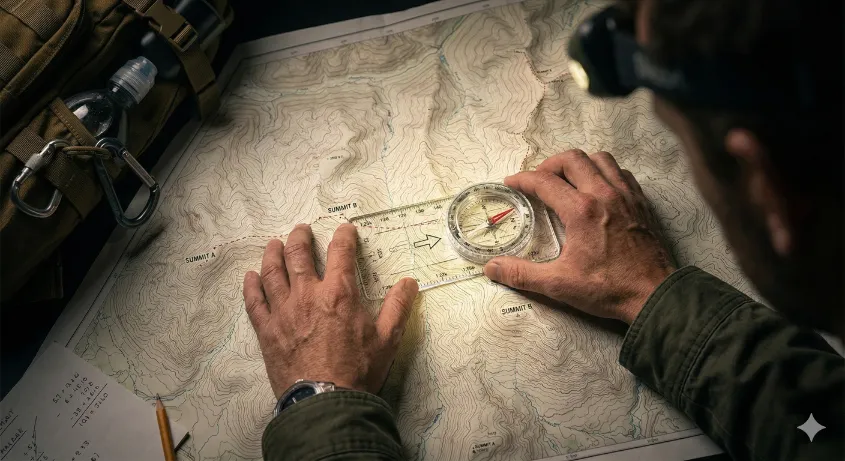
- Lay your topographic map on a flat surface.
- Place the straight edge of your compass baseplate so it connects Point A to Point B.
- Ensure the Direction of Travel Arrow is pointing exactly toward your destination (Point B).
- Without moving the baseplate, rotate the Bezel until the orienting lines inside the housing are perfectly parallel with the vertical North-South grid lines printed on the map. Make sure North on the bezel is pointing to the top of the map.
- Look at the Index Line. The degree number shown there is your True Bearing. (Don't forget to add or subtract your local magnetic declination before you start walking!)
Step 2: Following a Bearing (Walking the Line)
Now that you have your bearing locked into the compass bezel, it is time to put the map away and start hiking.
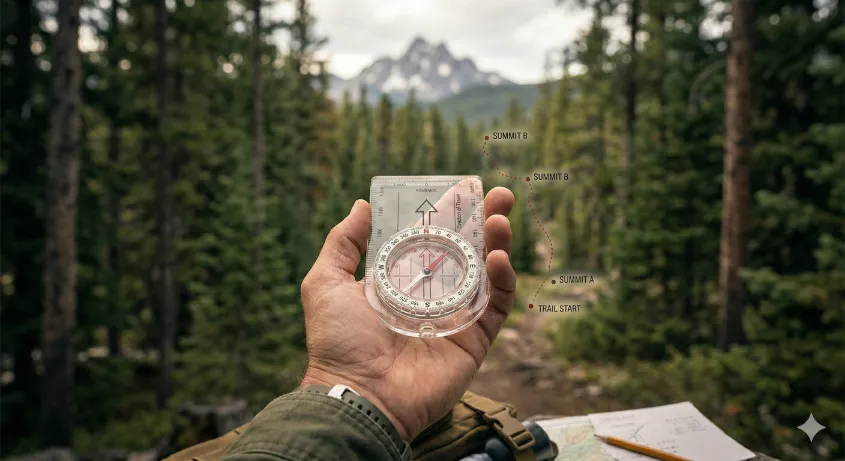
- Hold the compass perfectly flat in the palm of your hand, resting against your stomach. If it is tilted, the needle will drag and give a false reading.
- Make sure the Direction of Travel Arrow is pointing straight ahead of your body.
- Turn your entire body (not just your wrist) until the red end of the Magnetic Needle floats perfectly inside the outline of the Orienting Arrow. This is universally known as putting "Red in the Shed".
- Look up. The direction your body is facing is exactly where you need to go.
- To avoid staring at your compass while walking (which leads to drifting), look straight ahead and pick a prominent landmark—like an oddly shaped tree or a large boulder—that lies exactly on your path. Walk to that landmark, then check your compass again and pick a new landmark.
Compass Use FAQs
Can metal objects mess up my compass reading?
Yes. Compasses rely on the Earth's subtle magnetic field. If you hold your compass near a metal belt buckle, a smartphone, a heavy camera lens, or even the hood of a car, the needle will be drawn toward that local metal instead of Magnetic North, throwing off your bearing entirely.
What is a sighting mirror on a compass used for?
More advanced compasses have a fold-out mirror. This allows you to hold the compass at eye level and sight a distant landmark precisely through a notch, while simultaneously looking down into the angled mirror to ensure the magnetic needle is perfectly aligned in the orienting arrow. It provides much higher accuracy over long distances.
Can I just use my phone's digital compass?
Digital compasses use internal MEMS magnetometers to provide an excellent, highly accurate reading. They are fantastic for everyday use and quick bearings. However, phones rely on batteries and are susceptible to water and cold damage. In the wilderness, your phone should be your primary tool, but a mechanical baseplate compass must be your backup.