We rely on our smartphones to navigate through dense cities and remote wilderness alike. But without a physical, magnetized needle floating in liquid, how does a piece of glass, metal, and silicon actually know which way is North? The answer lies in a combination of microscopic hardware and advanced web APIs.
The Hardware: MEMS Magnetometers
Traditional compasses use a lightweight magnetic needle that physically rotates to align with the Earth's magnetic field. Smartphones, however, use a solid-state microchip known as a MEMS (Micro-Electromechanical System) magnetometer.
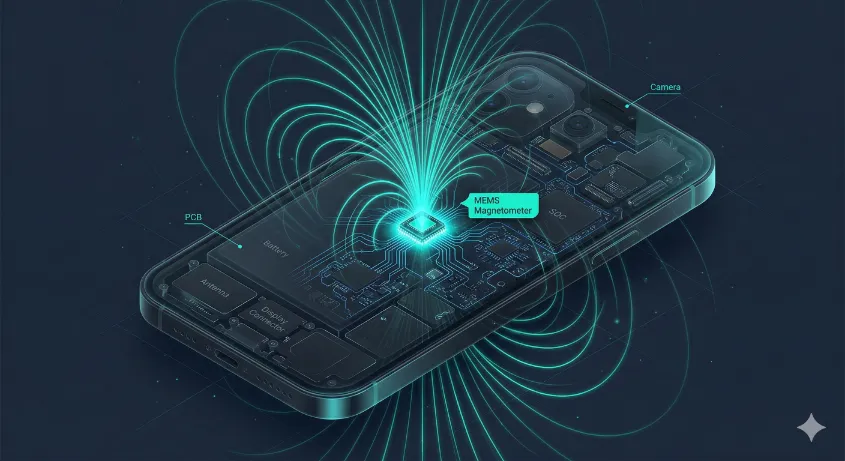
These tiny sensors—often no larger than a grain of rice—do not have spinning needles. Instead, they rely on electromagnetism and quantum physics, specifically the Hall Effect or Magnetoresistance.
The Physics: The Hall Effect
When an electrical current flows through a conductive plate inside the sensor, the electrons usually travel in a straight line. However, when the phone is exposed to a magnetic field (like the Earth's), the Lorentz force deflects these electrons to one side of the plate. This creates a measurable voltage difference across the conductor, known as the Hall voltage (V_H).
(Where $ is current, $ is the magnetic field strength, $ is charge carrier density, $ is the elementary charge, and $ is the thickness of the plate.)
By measuring this microscopic change in voltage, the phone's processor can determine exactly how strong the magnetic pull is from a specific direction.
The 3-Axis Coordinate System
The Earth's magnetic field doesn't just pull horizontally; it pulls down into the ground (magnetic inclination). To accurately determine direction no matter how you hold your phone, the magnetometer measures the magnetic field across three distinct axes:
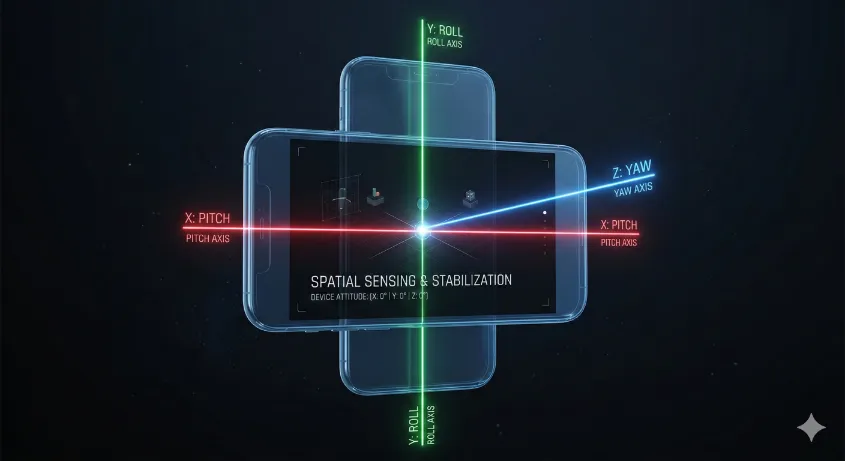
- X-Axis (Pitch): Tilt forward and backward.
- Y-Axis (Roll): Tilt side to side.
- Z-Axis (Yaw): Rotation while lying flat (the actual compass heading).
The raw data from these three axes is combined with data from your phone's accelerometer (which detects gravity) to mathematically calculate a flat compass bearing, even if you are holding your phone at an awkward angle.
Traditional Compass vs. Digital Compass
| Feature | Traditional Magnetic Compass | Digital Smartphone Compass |
|---|---|---|
| Mechanism | Physical magnetized needle | Solid-state MEMS sensor |
| Power Source | None (Earth's magnetic field) | Phone Battery |
| Tilt Sensitivity | Must be held perfectly level to work | Auto-compensates using accelerometers |
| True North Capability | Requires manual declination math | Can auto-calculate True North using GPS location |
Interfacing with the Browser: The DeviceOrientation API
In the past, accessing this hardware required downloading a native app from an app store. Today, modern HTML5 web browsers (like Chrome, Safari, and Firefox) expose this hardware data securely through the DeviceOrientation API.
When you grant an online compass tool permission to access your motion sensors, JavaScript code begins listening for `deviceorientationabsolute` events. The browser calculates the complex math and hands the web developer a clean data object containing the `alpha` value (your exact rotation around the Z-axis relative to Earth's magnetic north). The web app then uses CSS to smoothly rotate the digital compass dial on your screen in real-time.
Frequently Asked Questions
Does a digital compass need the internet or cellular service?
No. The MEMS magnetometer is a physical hardware sensor inside your phone. It reads the Earth's magnetic field passively, just like a traditional compass. Once a browser-based compass tool is loaded onto your screen, it can function completely offline without any cell service or Wi-Fi.
Can a magnet damage my phone's compass?
Bringing a strong magnet near your phone will temporarily disrupt the compass, causing it to point in the wrong direction (towards the magnet instead of North). However, because the MEMS sensor is solid-state, it will not be permanently magnetized or damaged. Once the magnet is removed, you may just need to recalibrate it using a figure-8 motion.
Why does my phone compass point the wrong way?
Smartphones are constantly exposed to "hard iron" and "soft iron" interference from phone cases, car chassis, and nearby electronics. The phone's operating system usually filters this out, but occasionally the algorithm gets confused. Moving your phone in a sweeping "figure-8" motion forces the sensor to map its 3D magnetic surroundings and reset its baseline accuracy.